Understanding Healthy Boundaries for Personal Growth

We’ve all heard it before: setting boundaries means putting up walls. Saying “no” feels selfish or unkind. Choosing yourself means leaving others behind.

But what if that’s not the whole story?

What if boundaries aren’t about shutting people out — but about putting down deep roots that keep you steady and strong?

Why Boundaries Matter

For many women, boundaries feel unfamiliar or even uncomfortable. Maybe you weren’t taught how to set them or haven’t seen them modeled in your life. You learned to say “yes” to keep peace, to be helpful, to be “good.”

But in saying yes too often, you might have lost touch with your own needs.

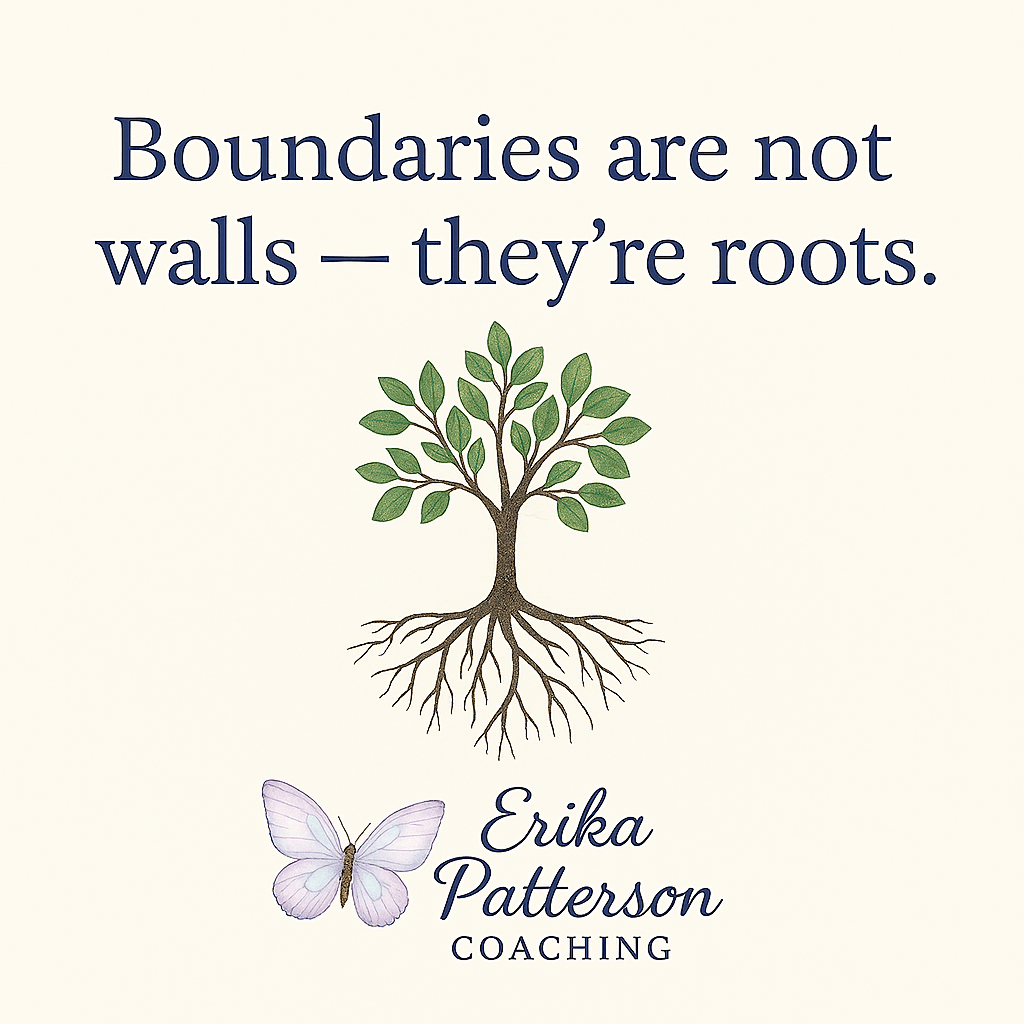
Healthy boundaries aren’t walls that block others. They are the roots that nourish your growth and keep you grounded.

They help you:

  • Stay connected to who you really are
  • Protect your energy
  • Show up fully — for yourself and the people you care about

The Journey to Setting Boundaries

Setting boundaries can feel shaky at first. You might notice feelings of resentment or exhaustion that you hadn’t fully acknowledged before. That’s normal.

Drawing lines where there were none takes courage and practice.

But every time you honor your limits, you come a little closer to yourself.

You’re allowed to:

  • Say no without needing to explain
  • Rest when you’re tired, even if others don’t understand
  • Protect your peace with kindness — especially toward yourself

A Gentle Invitation

This month, I’m offering a free reflection guide called “Returning to Yourself” — designed to help you set boundaries from a place of clarity and compassion.

Inside, you’ll find:

  • Journal prompts to reconnect with your needs
  • Simple practices to help you stay grounded
  • Space to explore what you’re ready to release and reclaim

👉 Download your free guide here

Remember, boundaries aren’t walls — they are roots.

They hold you steady so you can grow stronger and more true to yourself every day.

Midlife Awakening: How to Take Back Your Life

There’s a moment — quiet but unmistakable — when you realize:

You’ve lost yourself.

Not all at once, not in a dramatic collapse. But slowly, in the name of care, responsibility, love, and survival… you became who everyone else needed you to be.

The nurturer. The fixer. The one who holds it all together.

And now?
You’re exhausted. Disconnected. Maybe even resentful.
But more than anything, you’re ready.

Ready to reclaim the parts of you that got left behind.


The Cost of Being Everything

So many women arrive at midlife with a deep ache — not just from burnout, but from years spent shrinking, shifting, or stretching themselves to meet others’ needs.

You were the reliable one. The strong one. The peacekeeper.

You knew how to make things work — for everyone else.
But in the process, you stopped asking what you needed.
You forgot what it felt like to want something just for you.

This forgetting isn’t a personal flaw — it’s a patterned response, especially for women who’ve spent years in chronic caregiving, high-responsibility roles, or survival mode.


The First Step Back to You

Returning to yourself means learning to protect your energy and honor your limits — without guilt.
It means saying “yes” to what nourishes you, and “no” to what drains you.

And that’s where boundaries come in.

Boundaries aren’t walls. They’re roots.
They keep you steady, grounded, and strong enough to show up fully for yourself and for the people you care about.


💬 Feeling the pull to come home to yourself?

I created something for you:
Boundaries: Reclaim Your Energy & Protect What Matters
A free guide to help you understand, set, and keep boundaries with clarity and compassion.

Inside, you’ll find reflection prompts, real-life examples, and simple, actionable steps to start honoring your needs today.

Click here to download your copy


Returning to yourself isn’t selfish.
It’s sacred.

Because when you stop abandoning yourself, everything in your life begins to shift — toward peace, truth, and the freedom to finally be you again.

- Erika Patterson

© Erika Patterson Coaching 2025. All rights reserved.

She Wasn’t Handed a Damn Thing—But She’s Still Rising

Some women are handed a map.


She had to carve the path with her own two hands.

She wasn’t handed peace.
Or protection.
Or an easy out.

Life threw its punches—
and she took them.

She spit out the blood.
Swallowed the tears.
And kept going.

Her story?
It’s not tidy.
It’s not a highlight reel.
It’s full of heartbreak and hard choices,
shaky hands and sleepless nights,
moments where her spirit whispered, “I can’t,”
but her feet kept moving anyway.

This—
this is what resilience really looks like.

It’s not polished.
It’s not Instagram-worthy.
It’s not wrapped in daily affirmations or curated vision boards.

It’s raw.
It’s real.
It’s getting up again—when no one even knows how hard it was to open your eyes that morning.


If this is you… welcome.

You’re not broken.
You’re not behind.
You are not too much, and you are certainly not not enough.

You are a woman who’s been surviving in a world that hasn’t made it easy.
But you’re here now.

Not just to survive—
but to rise.

Not because you’re done being tired,
but because some part of you—
maybe a tiny, trembling part—
still hopes there’s more than just this.

And there is.


There’s a version of you…

Who knows how to breathe again.
Who trusts her own voice.
Who says no without guilt and yes without fear.
Who sees overwhelm not as her identity,
but as a signal—
a whisper that something needs to shift,
and that she is allowed to shift with it.

This isn’t about pretending life isn’t hard.
It’s about meeting that hard with gentleness
and finally asking:

“What if I don’t have to do this alone anymore?”


You don’t. Not now. Not here.

This is your invitation:
To lay down the weight.
To catch your breath.
To remember who the hell you are underneath the exhaustion.

You are not too late.
You are not too far gone.
You are not broken beyond repair.

You are a phoenix.

And this?
This isn’t your ending.


This is your rise.

Recognizing Overwhelm: Signs and Solutions

Overwhelm doesn’t just live in your mind — it lands in your body.

It can show up as:
• Tight shoulders or a stiff jaw
• A racing heart or shallow breath
• A sudden headache or wave of fatigue
• A knotted stomach or loss of appetite
• Sleepless nights or restless energy
• That urge to clean everything right now

When you’re overwhelmed, what shows up first?

Do you feel tightness in your chest?
Do you get snappy, numb out, or suddenly need to organize everything?

Drop a comment and name it — no judgment, just awareness.

🫶 Sometimes the first step to clarity is simply noticing.

Leave a comment

Overcoming Overwhelm: Finding Clarity Amidst Chaos

Sometimes, it looks like smiling through the storm.

Getting through the day but forgetting how to breathe.

If this feels familiar… you’re not alone.

This week, I’m diving into the hidden layers of overwhelm — and how we begin again with breath, boundaries, and micro-moments of clarity.

Stick with me. It’s not about overhauling everything.

It’s about starting here.

When ‘Nice’ Becomes a Cage

Setting boundaries with family, partners, or at work can feel like walking a tightrope — especially when you’ve been conditioned to be “the nice one.” In this post, I share the personal cost of over functioning, what helped me rewrite my story, and practical, guilt-free ways to start honoring your limits without losing yourself in the process.

Part 5: Boundaries with Family, Partners, and Work – Without the Guilt


Let’s be honest:
It’s one thing to talk about boundaries…
It’s another thing entirely to set them — especially with the people closest to you.

The ones you love.
The ones who raised you.
The ones who rely on your “yes” to stay comfortable.
The ones who don’t even realize they’re crossing a line.

This is where boundary work gets tender — and deeply personal.

Because when you’ve been conditioned to be “the nice one,”
saying no can feel like betrayal.

You might ask yourself:
What if they think I don’t care?
What if this changes everything?
What if they push back… or worse, pull away?

I’ve lived those questions.
For years, I tiptoed around boundaries because I didn’t want to be seen as ungrateful, cold, or “too much.”

Especially as a woman who’s survived trauma, raised children, carried emotional labor at work and home — I became the fixer. The over-functioner. The emotional first responder.

And it came at a cost.

I didn’t just stretch myself thin — I nearly disappeared in the process.

It wasn’t until I hit a quiet breaking point that I realized:

✨ Being endlessly available doesn’t make me good. It makes me exhausted.
✨ Being nice doesn’t mean being self-sacrificing.
✨ Being loving doesn’t mean abandoning myself.

The hardest boundaries I ever set were the ones that forced me to rewrite the story I had lived for too long:

That love means overextending.
That my needs come last.
That discomfort must be avoided at all costs.

But I started telling a new story:
One where I was worthy of protection.
One where boundaries and love could coexist.
One where peace didn’t require permission.


Practical Tips to Set Boundaries Without Guilt

Start Small and Practice Saying No
You don’t need to overhaul your entire life overnight. Begin with small “no’s” in less difficult situations. Each one builds your confidence and makes the next boundary easier.

Use “I” Statements to Keep It Personal
Express your needs in a way that focuses on how you feel and what you need, rather than what others are doing wrong. For example, say “I need some downtime after work to recharge” instead of “You’re too demanding.”

Prepare for Pushback, and Stay Grounded
People might resist your boundaries, especially at first. Their discomfort doesn’t mean you’re wrong. Remember: Your boundary protects your well-being, and that’s valid.

Recognize Guilt as a Sign You’re Growing
If guilt creeps in, notice it — but don’t let it stop you. It’s often a sign you’re breaking free from old patterns, which takes courage.

Prioritize Self-Care as a Boundary Reinforcer
When you care for yourself with rest, hobbies, or quiet time, you build the strength to maintain your limits. Self-care is not selfish; it’s survival.

Create Clear, Consistent Limits at Work
Communicate your availability and workload clearly to your team. Set expectations around your work hours and deadlines. Saying no to some tasks doesn’t make you less committed — it makes you sustainable.

Seek Support from People Who Understand
Surround yourself with those who respect your boundaries and encourage your growth. Having a support system makes this work feel less isolating.

Remember: Boundaries Protect Relationships
Boundaries aren’t walls to keep people out. They’re bridges to healthier connections. When you protect your energy, you show up more fully and authentically in your relationships.


If you’re navigating relationships where boundaries feel tangled with guilt or fear, I invite you into a free Clarity Call — a 60-minute 1:1 session where we can gently unpack what you’re carrying and explore a path that honors you.

No pressure. Just space.
To reclaim your time.
Your voice.
Your energy.

🦋 Book your Clarity Call here

Spots are limited, but the space is yours if you need it.


Up next in this series:
When the Boundary Is With You — Breaking the Overfunctioning Habit

With deep understanding and care,
Erika
Part 3: Letting Go of What Was Never Yours to Hold

The Cost of Invisible Work


We’re taught that strength means holding it all.

But what if real strength is learning how to let go?

For many of us, emotional labor has become a second skin — invisible but constant.
We manage everyone else’s emotions, smooth conflict, anticipate needs, and show up composed no matter what’s happening inside.

At some point, we forget what it feels like to simply be — without performing.


The Lie We’ve Inherited

We’ve absorbed the belief that:

  • Love means self-sacrifice.
  • Being needed means being worthy.
  • Our care only matters if it costs us something.

But that’s not care — that’s depletion dressed up as devotion.

The truth is:
You don’t have to carry what’s not yours in order to be good, worthy, or strong.


Releasing Isn’t Abandonment

Letting go of emotional labor doesn’t mean you stop caring.
It means you stop over-caring to your own detriment.

It means:

  • You let people have their own emotions — without fixing them.
  • You step back from managing what others haven’t asked you to hold.
  • You prioritize rest, presence, and your own well-being — without guilt.

This is not selfish. It’s sacred.
And it’s the foundation of real, sustainable connection — with others, and with yourself.


A Gentle Practice for This Time

When you feel yourself absorbing someone else’s stress or emotional state, pause and ask:

“Is this mine to carry?”

If the answer is no — exhale.
Let it pass through you instead of settling in you.

Return to your breath.
Return to your body.
Return to yourself.


Closing Reflection

As you release what was never yours to carry,
may your heart grow lighter, your spirit kinder, and your soul more at peace.