
Understanding Healthy Boundaries for Personal Growth

We’ve all heard it before: setting boundaries means putting up walls. Saying “no” feels selfish or unkind. Choosing yourself means leaving others behind.

But what if that’s not the whole story?

What if boundaries aren’t about shutting people out — but about putting down deep roots that keep you steady and strong?

Why Boundaries Matter

For many women, boundaries feel unfamiliar or even uncomfortable. Maybe you weren’t taught how to set them or haven’t seen them modeled in your life. You learned to say “yes” to keep peace, to be helpful, to be “good.”

But in saying yes too often, you might have lost touch with your own needs.

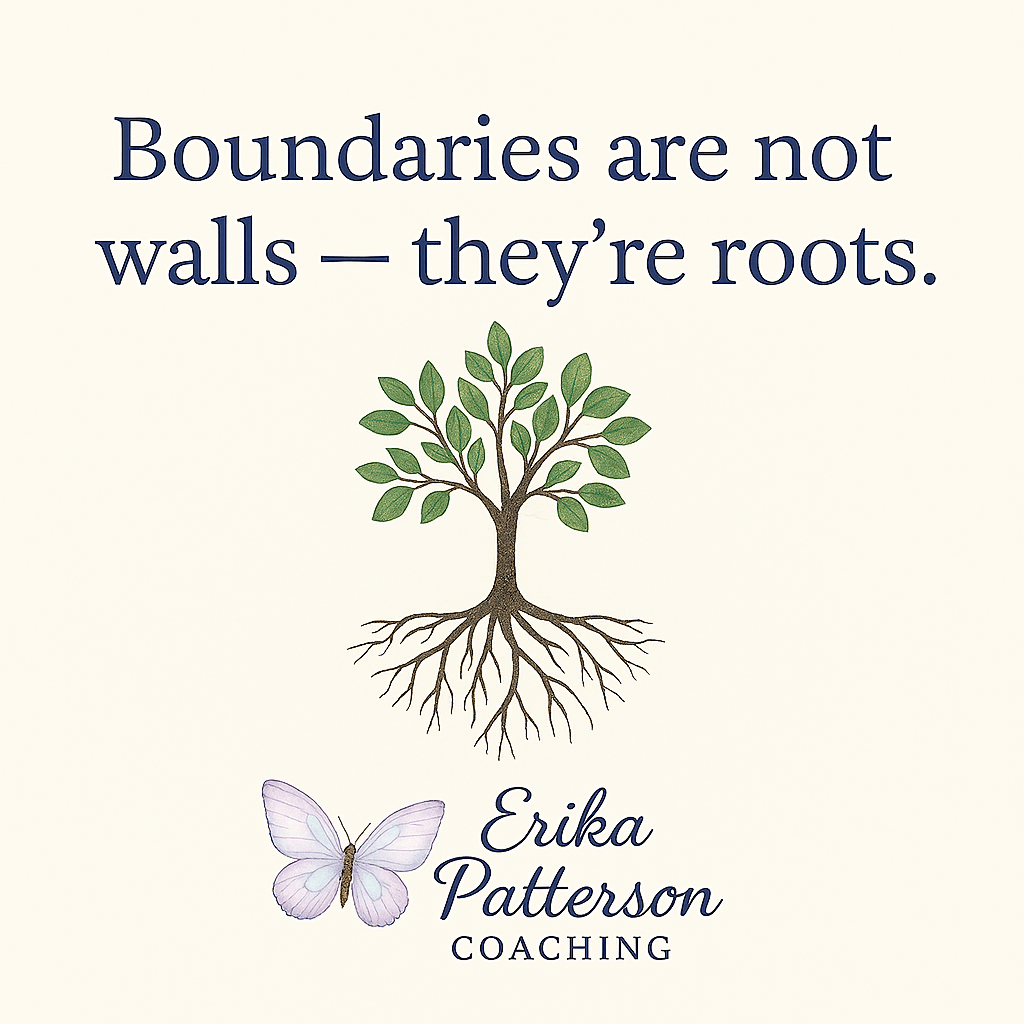
Healthy boundaries aren’t walls that block others. They are the roots that nourish your growth and keep you grounded.

They help you:

  • Stay connected to who you really are
  • Protect your energy
  • Show up fully — for yourself and the people you care about

The Journey to Setting Boundaries

Setting boundaries can feel shaky at first. You might notice feelings of resentment or exhaustion that you hadn’t fully acknowledged before. That’s normal.

Drawing lines where there were none takes courage and practice.

But every time you honor your limits, you come a little closer to yourself.

You’re allowed to:

  • Say no without needing to explain
  • Rest when you’re tired, even if others don’t understand
  • Protect your peace with kindness — especially toward yourself

A Gentle Invitation

This month, I’m offering a free reflection guide called “Returning to Yourself” — designed to help you set boundaries from a place of clarity and compassion.

Inside, you’ll find:

  • Journal prompts to reconnect with your needs
  • Simple practices to help you stay grounded
  • Space to explore what you’re ready to release and reclaim

👉 Download your free guide here

Remember, boundaries aren’t walls — they are roots.

They hold you steady so you can grow stronger and more true to yourself every day.

Midlife Awakening: How to Take Back Your Life

There’s a moment — quiet but unmistakable — when you realize:

You’ve lost yourself.

Not all at once, not in a dramatic collapse. But slowly, in the name of care, responsibility, love, and survival… you became who everyone else needed you to be.

The nurturer. The fixer. The one who holds it all together.

And now?
You’re exhausted. Disconnected. Maybe even resentful.
But more than anything, you’re ready.

Ready to reclaim the parts of you that got left behind.


The Cost of Being Everything

So many women arrive at midlife with a deep ache — not just from burnout, but from years spent shrinking, shifting, or stretching themselves to meet others’ needs.

You were the reliable one. The strong one. The peacekeeper.

You knew how to make things work — for everyone else.
But in the process, you stopped asking what you needed.
You forgot what it felt like to want something just for you.

This forgetting isn’t a personal flaw — it’s a patterned response, especially for women who’ve spent years in chronic caregiving, high-responsibility roles, or survival mode.


The First Step Back to You

Returning to yourself means learning to protect your energy and honor your limits — without guilt.
It means saying “yes” to what nourishes you, and “no” to what drains you.

And that’s where boundaries come in.

Boundaries aren’t walls. They’re roots.
They keep you steady, grounded, and strong enough to show up fully for yourself and for the people you care about.


💬 Feeling the pull to come home to yourself?

I created something for you:
Boundaries: Reclaim Your Energy & Protect What Matters
A free guide to help you understand, set, and keep boundaries with clarity and compassion.

Inside, you’ll find reflection prompts, real-life examples, and simple, actionable steps to start honoring your needs today.

Click here to download your copy


Returning to yourself isn’t selfish.
It’s sacred.

Because when you stop abandoning yourself, everything in your life begins to shift — toward peace, truth, and the freedom to finally be you again.

- Erika Patterson

© Erika Patterson Coaching 2025. All rights reserved.

When ‘Nice’ Becomes a Cage

The hardest boundary you’ll ever set might not be with your partner, parent, or boss — but with yourself. In this final post of When “Nice” Becomes a Cage, we explore what it means to stop overfunctioning, reparent the part of you that learned to earn love through exhaustion, and finally rest without guilt. This isn’t the end — it’s the beginning of coming home to you.

Part 6: When the Boundary Is with You — Breaking the Habit of Over Functioning


Sometimes the hardest boundary isn’t with a partner, a parent, or a boss.
It’s not with the people around you.
It’s with you.

It’s that quiet, familiar voice that urges you to say yes — even when your body’s begging for rest.
It’s the reflex to jump in, fix it, smooth it over, take it on…
Because that’s what you’ve always done.

This is what over functioning looks like.

And it doesn’t happen in a vacuum.

It’s shaped by survival.
By childhood roles.
By trauma and identity.
By being “the strong one” — the one who holds it all together.

Over functioning wears the mask of competence and care.
But underneath?
There’s often fear.

Fear of letting people down.
Fear of being forgotten if you’re not useful.
Fear of sitting with your own unmet needs.

I know this place deeply.
I lived there for years.

Professionally, I over-delivered.
Personally, I self-abandoned.
I believed being needed meant I mattered.

But eventually, the weight broke me open.

The most radical shift in my healing didn’t come from saying no to others.
It came from saying no to myself — to the part of me that was addicted to overfunctioning.


🕊 Reparenting the Over Functioner Within

Often, the part of us that overfunctions is still trying to earn love, safety, and belonging — as if we’re stuck in a younger version of ourselves who had to be helpful to be seen.

Breaking that habit meant learning to reparent myself:

To speak to that younger version gently.
To say:
“You’re not responsible for holding the world anymore.”
“You don’t have to earn your place here.”
“It’s okay to let go — I’ve got you now.”

Setting a boundary with yourself sometimes looks like protecting that younger part from old patterns that no longer serve your present life.


🌿 Quiet, Sacred Boundaries

I had to learn to speak new truths:

🌀 “You don’t have to take that on.”
🌀 “It’s not your job to carry other people’s comfort.”
🌀 “You are allowed to rest — without earning it first.”

These weren’t loud boundaries.
They weren’t dramatic.
But they were revolutionary.

They gave me back my breath.
They reintroduced me to myself.


💬 Reflection & Growth: Journal Prompts

If you’re ready to look more closely at your own patterns, try journaling on one or more of these:

  • Where in your life do you feel the need to constantly prove your worth?
  • What’s something you wish someone would say to you when you’re overwhelmed?
  • What would shift if you trusted that being loved doesn’t require being everything?

Let these questions stir — not as problems to solve, but as gentle openings into something more truthful.


🌱 The Payoff: What You Gain When You Let Go

When you stop overfunctioning, you begin to feel your own aliveness again.
You reconnect with your body.
Your intuition gets louder.
You remember how to exhale.

✨ You make space for relationships built on mutual care — not obligation.
✨ You discover joy in your own enoughness.
✨ You begin living from a place of being, not proving.


🌿 Clarity Call Invitation

If this series has stirred something in you — if you’re feeling the ache of overfunctioning, the burnout of emotional labor, or the longing to come back home to yourself — I invite you into a free 60-minute Clarity Call.

This is a private, compassionate space to explore:
✨ What you’ve been holding
✨ Where you’re stretched too thin
✨ What it might feel like to finally breathe again

🦋 Book your Clarity Call here
This space is yours, if you’re ready to step into it.


Thank you for walking with me through this series.

We’ve explored the cost of emotional labor, the cage of “being nice,” the ache of saying no, and now — the quiet revolution of choosing yourself.

This isn’t the end.
It’s the beginning.


🔑 Empowered Affirmation to Carry Forward

“I am no longer the keeper of everyone’s comfort. I choose rest — not because I’ve earned it, but because I exist.”


🔔 Stay Connected

If this series spoke to your heart, there’s more to come.

Subscribe for future series from Erika Patterson Coaching — thoughtful, soul-deep reflections to help you navigate real life with more clarity, boundaries, and self-trust.

Lighting the Way from Overwhelm to Opportunity.
You don’t have to walk this path alone.

When ‘Nice’ Becomes a Cage

Boundaries aren’t walls to keep people out — they’re bridges to deeper, healthier relationships. For too long, I believed saying ‘yes’ made me kind and saying ‘no’ made me difficult. But the truth? Boundaries are the most radical act of self-love I’ve ever learned.

Part 2: Boundaries: What They Really Are.


Boundaries get a bad rap.

They’re often seen as walls. Barriers. Coldness.

The thing we put up when we want to push others away.

But here’s the thing:

Boundaries aren’t about shutting people out — they’re about holding space.

Space for your needs.

Space for your feelings.

Space for your health.

Space to be yourself.

A boundary is a gentle but firm yes to what you need, and a clear no to what drains you.

It’s a way of caring for yourself that says:

“I matter. My energy matters. My wellbeing matters. “


I’ll be honest — setting boundaries has not come easily to me.

I am a lifelong yes person — eager to help, quick to say yes, and slow to say no.

For a long time, I thought saying yes was kindness.

But over time, I realized that when we don’t set boundaries, people can — and sometimes do — take advantage.

It took me years to learn that saying no isn’t selfish; it’s self-care.

And sometimes, setting a boundary sounds as simple as:

  • “I’d love to help, but I don’t have the capacity right now.”
  • “I need some time to think about that before I commit.”
  • “I’m not available for that, but I hope it goes well.”
  • “I don’t feel comfortable with that topic — can we shift the conversation?”
  • “That doesn’t work for me.” (Full stop. No justification required.)

Too often, we confuse boundaries with rejection.

We worry saying no will make others angry or disappointed.

Or that setting limits means we’re being selfish or unkind.

But here’s a secret:

Boundaries are kindness — to yourself and to others.

They teach people how to treat you.

They create trust.

They build respect.

When you set a boundary, you’re not saying “I don’t care.”

You’re saying:

“I care about myself enough to protect my heart and my time.”


Of course, boundaries can feel scary or unfamiliar.

Especially if you’ve spent years putting everyone else first.

But every boundary you set is a step toward freedom.

Freedom to show up fully — without resentment, exhaustion, or overwhelm.


In the next post, we’ll explore:

Why Saying No Feels Like a Betrayal — And Why It’s Not

If this speaks to you, I’d love to hear your thoughts.

Hit reply or share this with someone who could use a little boundary kindness today.

With care,

Erika

When ‘Nice’ Becomes a Cage

Somewhere along the way, we were taught that being a ‘good woman’ meant being agreeable, accommodating, and selfless — even at the cost of our well-being. But behind every forced smile and quiet ‘I’m fine’ is a woman who’s been shrinking herself to fit a story that was never hers. It’s time we question the myth of nice — and reclaim the fullness of who we are.

Part 1: The Myth of a Good Woman — How ‘Being Nice’ Has Cost Us Too Much

From the earliest moments of our lives, we are taught a subtle, unspoken lesson:

To be good is to be nice.
To be seen is to be quiet.
To be loved is to be accommodating.

It sounds simple enough, wrapped in gentle words:
“Be polite.”
“Don’t make waves.”
“Take care of others before yourself.”

But beneath this gentle teaching lies a heavy, invisible weight.

Because what we call being nice is often a complex, exhausting dance of survival — a survival learned from trauma, fear, and the desire to belong.

We learn to smooth our edges so we don’t scare others away.
We carry the emotional baggage of everyone around us — the unspoken needs, the silent hurts — as if it were our own.
We apologize for taking up space, for expressing pain, for being too much.
We fold ourselves into silence even when inside, we’re screaming.

And all the while, we wear this mask of niceness like armor — fragile, and yet so demanding.

But here is the truth most don’t say out loud:

Being nice is not the same as being kind.

Kindness is rooted in presence — an authentic honoring of both ourselves and others.

Niceness, by contrast, is often rooted in performance — a scripted behavior shaped by fear of rejection, conflict, or abandonment.

When we choose niceness over truth, we sacrifice the most vital parts of ourselves: our voice, our boundaries, our worth.

We swallow our honest feelings to keep the peace.
We enable harmful patterns because confronting them feels too risky.
We become invisible caretakers, holding the world together at the expense of our own sanity.

But silence is not kindness.
Self-abandonment is not compassion.
Saying yes when every fiber of your body says no is not generosity — it is a slow erasure of self.

Behind many smiles lies a quiet desperation: burnout, loneliness, resentment, and exhaustion from pretending that everything is fine.

In our last series, we named the invisible work that women do every day — the emotional labor that holds families, friendships, and workplaces together.

Now, it’s time to name the cost of that labor.

It’s time to stop over-giving, to stop sacrificing ourselves for others’ comfort.

Because you deserve more than survival.

You deserve boundaries that feel like safety — not prisons.
You deserve relationships rooted in respect — not fear.
You deserve to say “no” without guilt, and to hold your ground with love.

This series is a quiet revolution — a reclaiming of your power, your voice, and your heart.

It’s not about shutting people out or becoming cold.
It’s about becoming whole — fully alive and unapologetically you.

If you feel tired of carrying invisible burdens, if you’ve ever felt crushed beneath the weight of being “nice,” this series is for you.

Together, we will unravel the myths, heal the wounds, and build a new foundation — one where kindness and strength live hand in hand.

Because your worth is not measured by how pleasant you are.

It is measured by your courage to be real.


Coming up next:
What a Boundary Actually Is — And What It Isn’t

We’ll break down the myths around boundaries and explore what they look like when they’re rooted in love — not fear.

If this resonates, I’d love to hear from you.
Hit reply, or forward this to someone who needs to know: you don’t have to earn your worth by being pleasant.

With warmth,
Erika

Recognizing Overwhelm – The First Step to Change

We’ve all done it. Smiled when we were breaking. Said “I’m fine” with a throat full of tears. Juggled work, kids, caregiving, deadlines, expectations, bills — all while quietly managing the deep, hollow ache of loneliness. And somehow, we still show up. We hold the center. We do what needs to be done.

It becomes second nature. Expected, even.

And the more we hold it all together, the more invisible our overwhelm becomes. We disappear into our roles, our responsibilities, our shoulds.

But here’s the quiet truth no one tells you:
Holding it all together doesn’t make you strong.
It makes you vanish.

For decades, I wrote my thoughts, feelings, and stories—sometimes quietly, sometimes fiercely—but I didn’t always share them.
Now, I’ve stepped into the light.
I’ve moved beyond performing stability while quietly crumbling inside.
I’ve faced and honored my grief instead of tucking it away.
I’ve reclaimed my place—no longer living in the margins, but fully present in my own life.

And I realized — I wasn’t the only one.

So many women — especially those who’ve had to lead, protect, survive — become masters of emotional containment. We tidy our breakdowns into neat compartments. We swallow our needs. We shape-shift to fit what the world demands of us. And then we lie awake at night, wondering why we feel so far away from ourselves.

This isn’t strength.
This isn’t resilience.
This isn’t living.

Here’s what I believe now:
There is radical power in letting it fall apart.
In being seen in your softness.
In asking for help without shame.
In saying “I can’t carry this alone.”
In choosing rest over performance. Truth over image.
Wholeness over hustle.

The “Overwhelm Reset” isn’t about productivity hacks or color-coded calendars.
It’s about permission.

Permission to stop pretending.
Permission to step out of the roles that are costing you your peace.
Permission to unhook from perfection.
Permission to be human again.

This is your invitation.

To unlearn the myth.
To come home to yourself.
To stop performing wholeness and begin living in your truth — messy, real, unfiltered.
To let go of the version of you that always keeps it together — and make space for the version who breathes deeply, who tells the truth, who asks for what she needs, who receives.

If you’re feeling ready to take a next step toward reclaiming your energy and peace, I offer several coaching paths designed to support you at every stage—from gentle resets to deep transformation. Whether you’re looking for short-term relief or a longer journey home to yourself, there’s a place here for you.

Let’s begin there.
Together.

Erika